


For ship owners and managers
Fewer surprises per port call.
For owners and managers running one to forty vessels: the disbursement accounts, charter parties, SOFs and certificates that cost money when nobody has time to check them.
Start a DiagnosticHelmwize works with ship owners and technical managers who are too small for a full fleet-ERP programme and too busy to audit every port call by hand. We start with the workflows where money leaks quietly: disbursement accounts settled above the proforma, laytime lost because the SOF and the charter party were never compared, certificates that expire between crew changes, and PSC preparation that depends on one superintendent's memory. The Diagnostic maps those workflows against your PMS, agency and finance data in two to four weeks and sizes what each is worth. We prove the first one on live calls in fifteen to thirty days, then the platform runs inside your own cloud tenant so your operations team, not ours, owns it.
Where we start
Which workflows are worth fixing first?
Disbursement account control
Every final account compared to its proforma and the published tariff before settlement. Lines above tariff, unlisted surcharges and repeat patterns by agent are staged for a person to query. L3 Cost per transaction. Ledger: Port costs per vessel-day.
Laytime and demurrage
The SOF is read against the charter party clauses as the call unfolds, so exposure is known before the claim window closes rather than reconstructed months later. L1 Working capital. Ledger: Demurrage receivable / despatch payable.
Certificate and crew-change planning
Expiring certificates matched to the next crew-change port and reliever availability, with the gaps a person needs to fix surfaced weeks out, not days. L7 Risk avoidance. Ledger: Off-hire and detention avoided.
PMS data foundation
Work orders, spares and surveys resolved into one clean record per vessel, so every later workflow starts from data that can be trusted. L2 Cycle time. Ledger: Superintendent hours per vessel.
One real decision
A recommendation should be something you can inspect.
Time is counting. Nine hours thirty against the charterer.
- What changed
- NOR tendered 06:40 and accepted. Discharge commenced 22:10. Clause 14 allows six hours turn time; laytime started 12:40.
- Evidence
- SOF, p.2CP clause 14NOR email 06:40Port log
- Exposure
- US$14,250 demurrage accruing at US$36,000 per day
- Confidence
- High on times. Medium on whether the shifting clause suspends time between berths.
- 06:40NOR tendered
- 12:40Laytime starts (+6 h turn time)
- 18:05Shifted berth 3 → 5
- 22:10Discharge commenced
Suggested step
Notify the charterer that time is counting. Get the SOF signed at each event.
Illustrative workflow, not a client result. This example changes nothing outside the page: no notice, no claim, no message.
Systems of record
What stays authoritative?
PMS, Crewing system, Finance / ERP, Voyage management. Helmwize connects the context. It does not replace these systems.
For ship managers and owners
Four modules a fleet director can size in a week.
Disbursement leakage, demurrage exposure, certificate expiry and cyber evidence are the four lines a fleet director can size in a week. Each runs on data the PMS, VMS and crewing system already hold.
Disbursement account audit rules
Reads: Proforma DA, Final DA, Port tariff, Agency agreement, Prior calls at the same port. An exception register per port call: line item, proforma, final, variance, rule triggered, recommended action. GATE: A port-cost controller approves each write-back.
PLANNEDBUILD
Laytime and demurrage engine
Reads: Charter party, Statement of facts, Notice of readiness, Port log. A laytime statement with every clause applied, every exception listed, and the demurrage or despatch figure with its calculation shown. GATE: The claims handler approves the statement before it leaves the estate.
PLANNEDBUILD
PSC and certificate readiness matrix
Reads: Crew list, STCW, GMDSS and medical certificates, Seafarer employment agreements, PSC inspection history. A per-vessel matrix of certificate status, expiries at thirty, sixty and ninety days, MLC readiness and deficiency likelihood. GATE: The crewing manager confirms every action.
PLANNEDBUILD
IACS UR E26 / E27 evidence pack
Reads: Onboard and shore asset inventory, Vulnerability scans, Network zoning, Test procedures. An evidence pack mapped to the five functional aspects and seventeen requirements of UR E26, with gaps stated. GATE: The designated person ashore or CISO signs the pack.
PLANNEDPACKAGE
What you receive
Board-ready, not dashboard-ready.
Illustrative examples. Figures are representative, not client data.
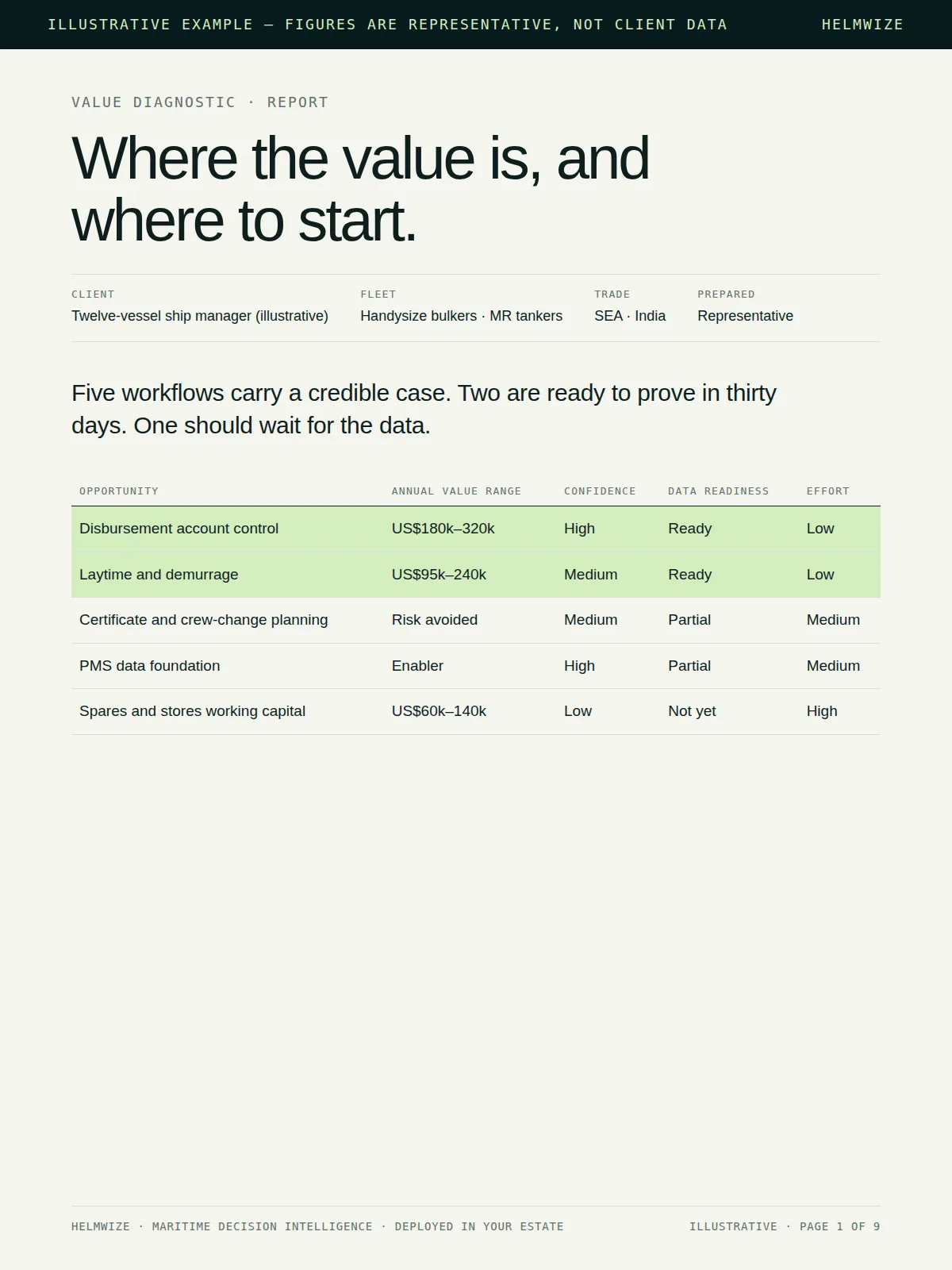
Value Diagnostic report
A ranked opportunity portfolio with sized levers, data readiness per system and a recommended Proof of Value scope. Audience: Managing director, CFO, fleet director.
Illustrative
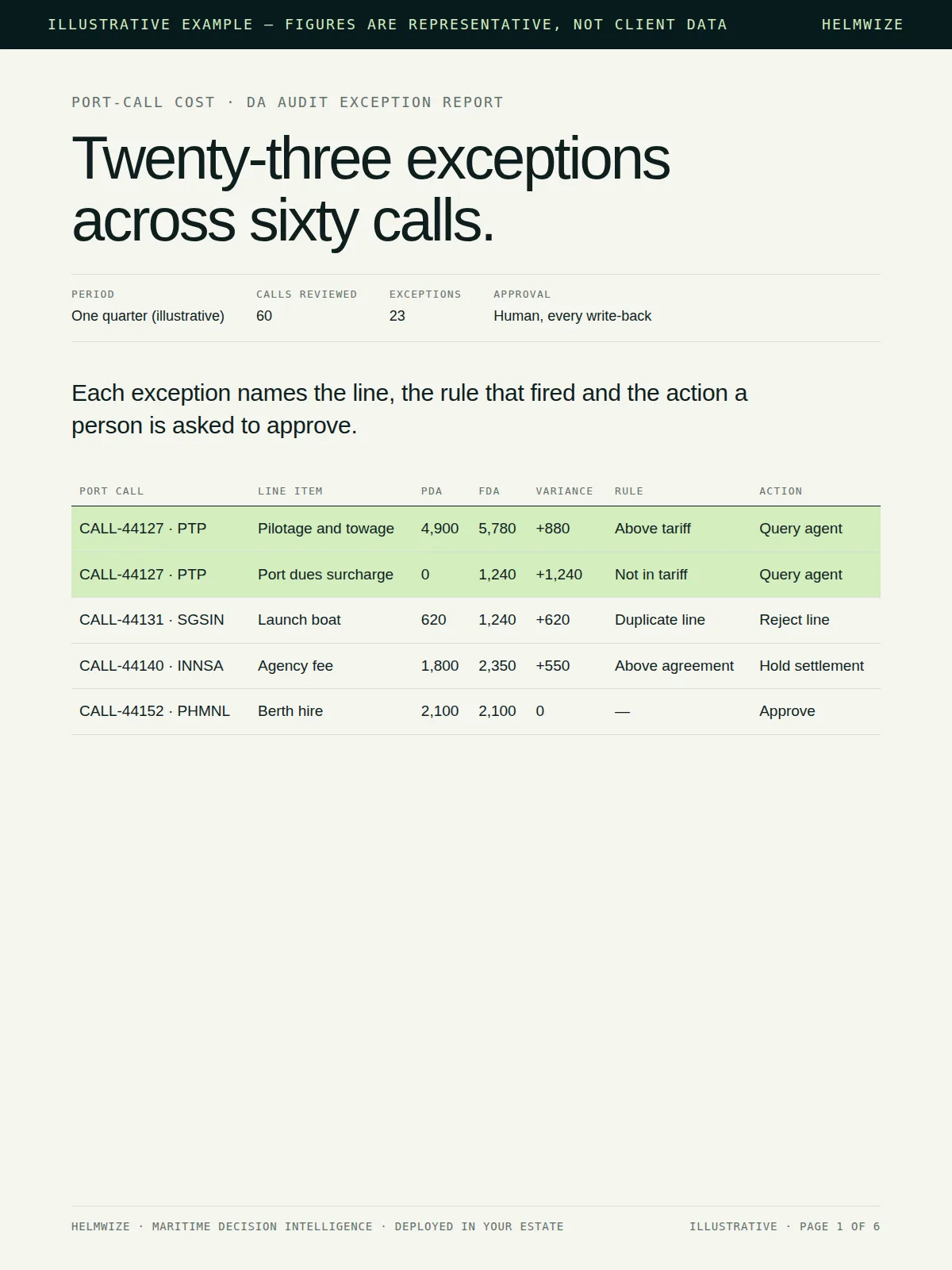
Port-call cost and DA audit exception report
An exception register per call with the rule that fired and the write-back a person is asked to approve. Audience: Port-cost controller.
Illustrative
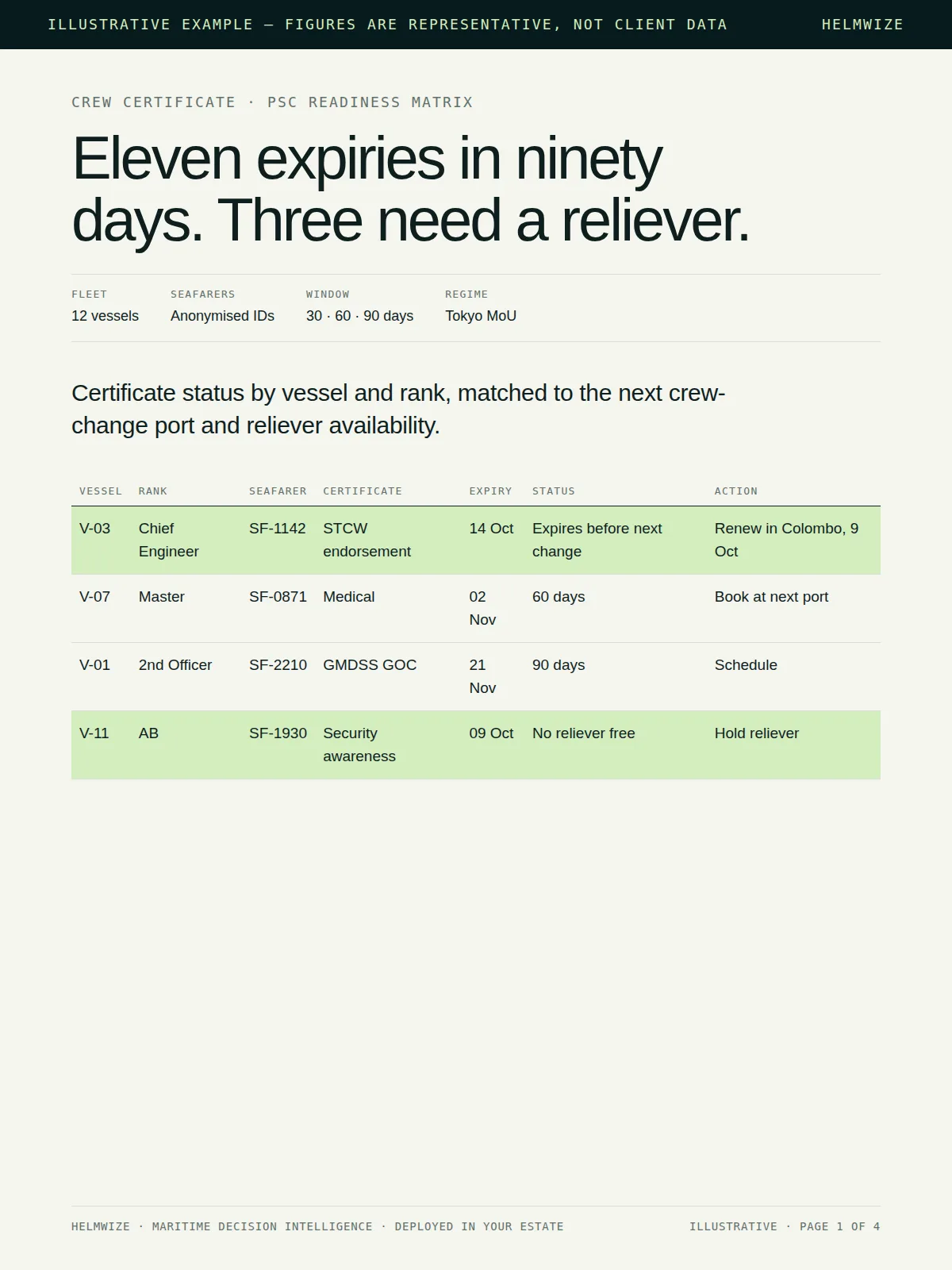
Crew certificate and PSC readiness matrix
Certificate status by vessel and rank, expiries at thirty, sixty and ninety days, MLC readiness and deficiency likelihood. Audience: Crewing manager, DPA.
Illustrative
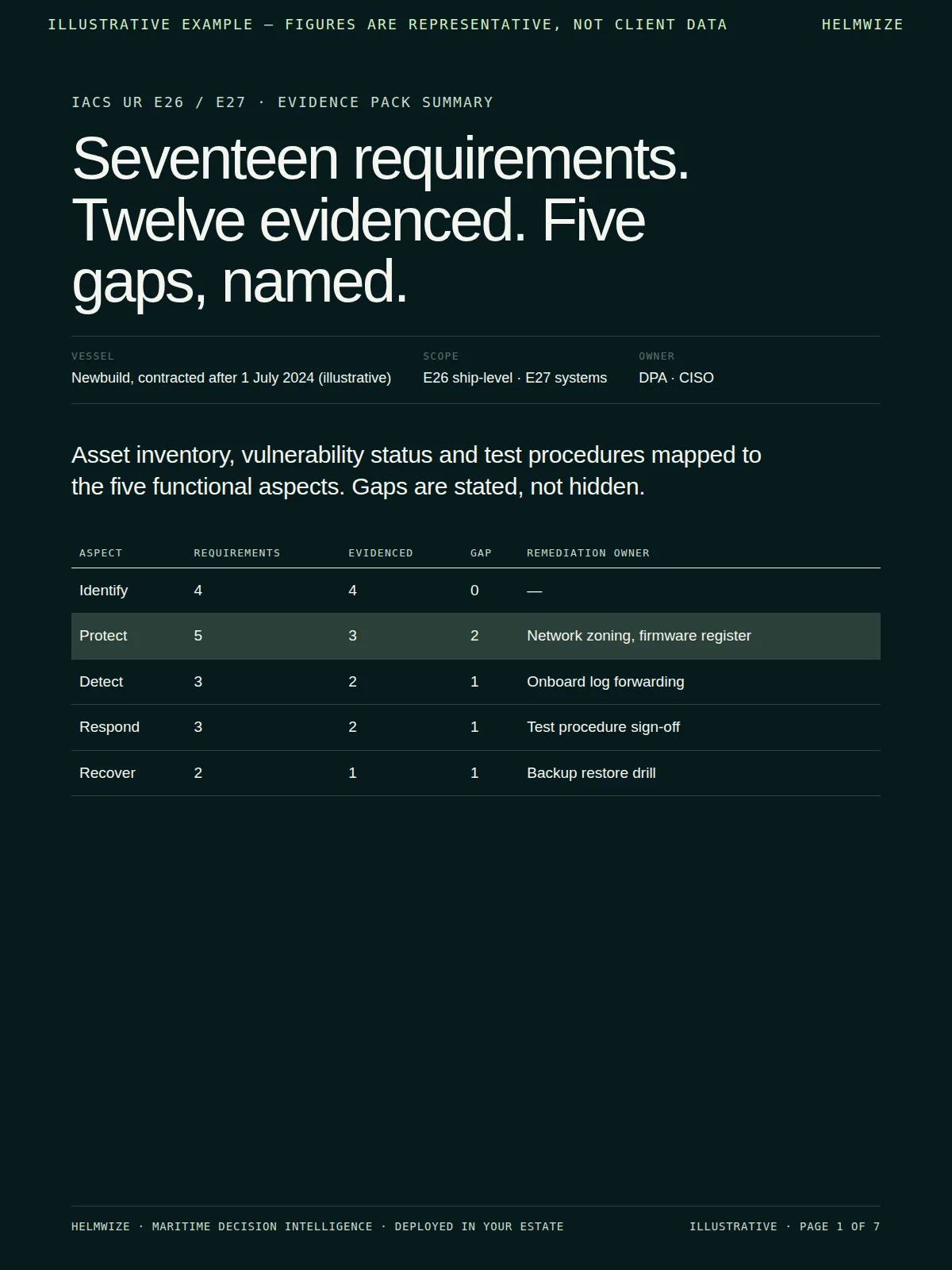
IACS E26 / E27 evidence pack summary
Asset inventory extract, vulnerability status and a mapping to the seventeen requirements with gaps stated. Audience: Designated person ashore, CISO, superintendent.
Illustrative
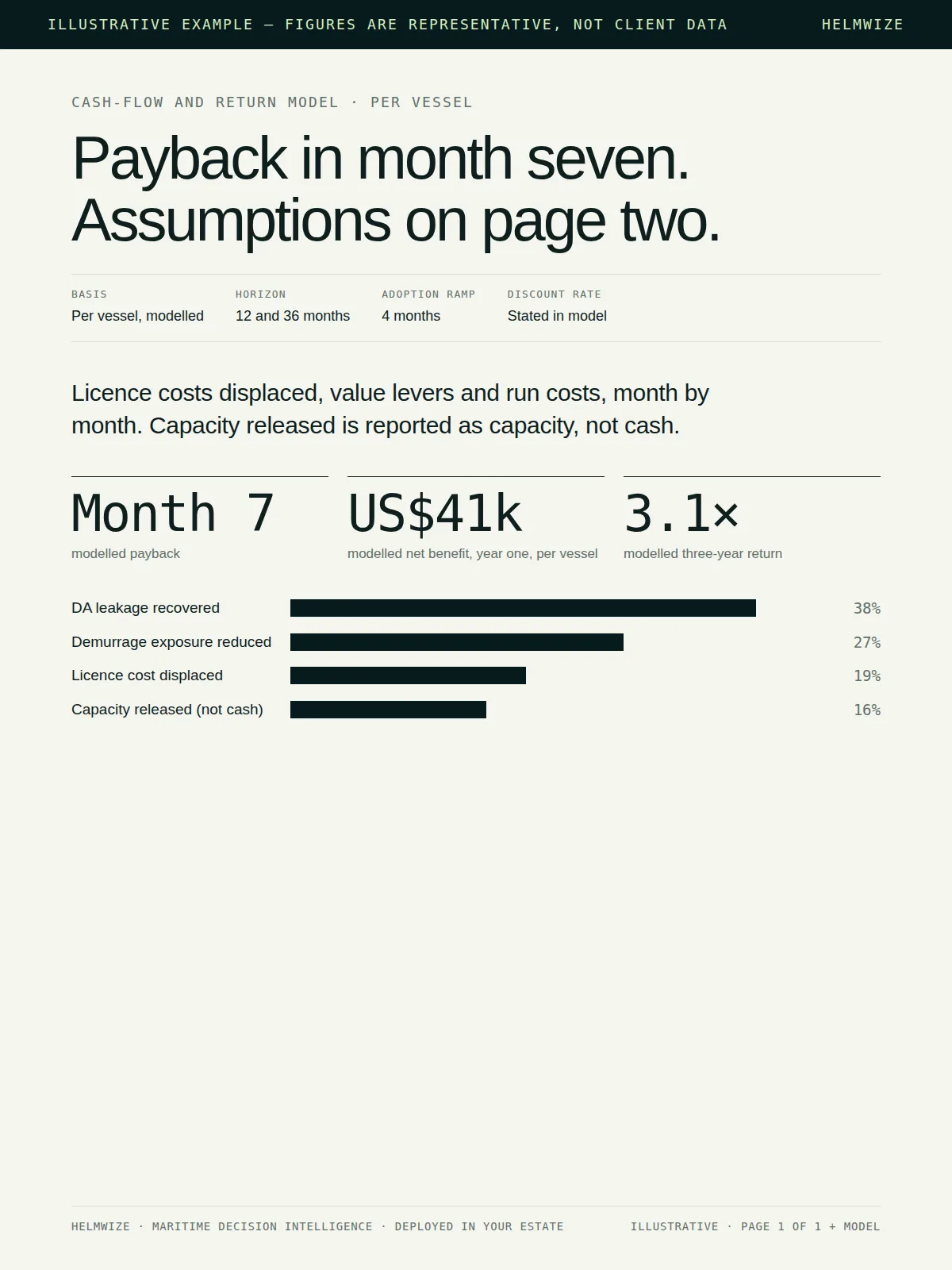
Cash-flow and return model
Twelve- and thirty-six-month cash flow per vessel and per site, licence costs displaced, payback month, all assumptions visible. Audience: CFO.
Illustrative
What you stop paying for
Keep the PMS. Drop the seats.
Representative ranges by category.
Costs are representative ranges by category · not vendor price lists
| Function | Incumbent | Representative cost | With Helmwize | Verdict |
|---|---|---|---|---|
| Fleet dashboards | Commercial BI suite | Representative: per-seat licences across superintendents and finance | Dashboards built on your own data | replace |
| Document extraction | Cloud OCR per page or enterprise IDP | Representative: five figures a year | Read into typed records in your estate | replace |
| Position data | Commercial AIS subscription | Representative: five figures a year | Position data from open feeds where coverage allows | reduce |
| Planned maintenance | Class-approved PMS | Stays | The platform reads it; the notation stays intact | integrate |
Compliance
What port state and class will ask for this year.
| Instrument | Body | Effective | Affects | Evidence needed |
|---|---|---|---|---|
| IACS UR E26 and E27 cyber resilience | International Association of Classification Societies | 2024-07-01 | Ships contracted for construction on or after the date, Yards, Equipment suppliers | Asset inventory, test procedures and evidence for seventeen requirements |
| Tokyo MoU concentrated inspection campaigns | Tokyo MoU on Port State Control | annual, September to November | Every vessel calling in the region | Signed seafarer employment agreements, wage records and certificate status on board |
| FuelEU Maritime penalties | European Union | 2025-01-01 | Owners and ISM companies trading to the EU | Compliance balance and penalty exposure per vessel |
| Singapore electronic bunker delivery note and mass flow meter requirements | Maritime and Port Authority of Singapore | 2025-04-01 | Bunker suppliers, Ship managers, Agents | Reconciled digital delivery records per stem |
FAQ
Questions
We only have a small fleet. Is this worth it?
The Diagnostic tells you your number before you commit. It does not assume a fleet size.
Our data is in a PMS, an agency portal and Excel. Is that enough to start?
Yes. Disbursement and laytime workflows start from documents and records you already have. Nothing new has to be installed on board.
Do we have to move to a new fleet-management system?
No. Your PMS and finance system stay authoritative. The platform reads them, stages recommendations and writes back only through actions a named person approves.