

THE PLATFORM
Keep your systems of record. Add the intelligence between them.
The Helmwize platform is an operating model for advice that ends at a ledger line. A signed goal becomes an observed process, a finding, a valued lever, an approved action, a named financial line, a measurement on the same ruler, a causal attribution and a memory for the next goal. It runs inside your environment.
Discuss a workflowThe Helmwize platform is Observe · Decide · Act, running inside your own environment, with the Maritime Pack kept current by Helmwize. We do not publish integration logos until the connector exists and has been tested.
01
What does it connect?
PMS, ERP, VMS, TOS, crewing, agency and DA portals, class and flag portals, charter parties, SOFs, BLs, surveys, tariffs, onboard logs. Integration categories: APIs, events, governed views, files, approved email. We do not publish integration logos until the connector exists and has been tested.
02
What does it do?
Connect
Bring permitted records and system exports into a shared context. Keep their origins visible.
Contextualise
The PMS, the agent, finance, the charter party, the SOF and the crew matrix stay authoritative.
Retrieve
Find the document, the tariff line, the certificate, the time in the SOF.
Calculate
Evidence and calculation on a frozen ruler.
Reason
A recommendation you can inspect: what changed, evidence, exposure, confidence, gap.
Act
Staged, not committed. Nothing is committed without a named person.
03
What are the six stages?
Research
Observe the process.
Diagnose
Find where AI creates measurable value.
Recommend
A recommendation you can inspect.
Operate
Run the workflow in your estate.
Measure
The same ruler used to approve the work.
Learn
A memory for the next goal.
04
What is the Maritime Pack?
The Maritime Pack: pain-point library, process backbone, KPI library, benchmarks with provenance, regulatory register, play library, lever instantiations, published gaps.
05
What is the doctrine?
Typed in, typed out
Inputs and outputs stay typed.
Engines hold no credentials
Secrets stay with the estate.
Staged, not committed
Nothing is committed without a named person.
One definition, never redefined
Every value claim is measured on the same definition that was used to approve the work.
Gaps published
Previous quarter's tariff page could not be sourced — recorded as a gap.
Authority
The AI never has more authority than the person using it.
Maritime Pack
The rules a generic stack does not ship.
Tracking, extraction, dashboards and workflow are commodities. What no generic platform contains is the maritime rule and evidence layer: laytime, disbursement audit, certificate readiness, cyber evidence. That is the Maritime Pack.
Laytime and demurrage engine
Reads: Charter party, Statement of facts, Notice of readiness, Port log. A laytime statement with every clause applied, every exception listed, and the demurrage or despatch figure with its calculation shown. GATE: The claims handler approves the statement before it leaves the estate.
PLANNEDBUILD
Disbursement account audit rules
Reads: Proforma DA, Final DA, Port tariff, Agency agreement, Prior calls at the same port. An exception register per port call: line item, proforma, final, variance, rule triggered, recommended action. GATE: A port-cost controller approves each write-back.
PLANNEDBUILD
IACS UR E26 / E27 evidence pack
Reads: Onboard and shore asset inventory, Vulnerability scans, Network zoning, Test procedures. An evidence pack mapped to the five functional aspects and seventeen requirements of UR E26, with gaps stated. GATE: The designated person ashore or CISO signs the pack.
PLANNEDPACKAGE
PSC and certificate readiness matrix
Reads: Crew list, STCW, GMDSS and medical certificates, Seafarer employment agreements, PSC inspection history. A per-vessel matrix of certificate status, expiries at thirty, sixty and ninety days, MLC readiness and deficiency likelihood. GATE: The crewing manager confirms every action.
PLANNEDBUILD
Maritime document schemas
Reads: Bills of lading, Charter parties, Statements of facts, Survey reports, Crew certificates, Yard quotations. Typed records from paper and PDF, with page and field provenance for every value. GATE: Low-confidence fields are queued for a person, never guessed.
PLANNEDPACKAGE
e-BDN and mass flow meter reconciliation
Reads: Electronic bunker delivery notes, Mass flow meter records, Bunker requisitions, Supplier invoices. A reconciliation per delivery with quantity, density and timing exceptions flagged for review. GATE: The bunker desk approves any dispute raised.
PLANNEDBUILD
Maritime Single Window and FAL evidence
Reads: FAL forms, Port call notifications, Single-window submissions, Vessel and cargo declarations. A per-call record showing which declarations were exchanged electronically, when, and what remains manual. GATE: The port authority owns the record; the platform only reports the gap.
PLANNEDBUILD
Dry-dock spec-to-quote comparison
Reads: Repair specification, Yard quotations, Prior dockings, Currency and unit conventions. A normalised comparison by work package with outliers and clarification questions listed. GATE: The technical superintendent decides the award.
PLANNEDBUILD
Berth and yard turnaround truth
Reads: Terminal operating system event logs, Vessel call records, Berth plans, Tariff. Turnaround decomposed from arrival to departure, berth productivity, and the bottlenecks that cost money. GATE: The terminal reads its own event log; nothing is written back.
PLANNEDBUILD
What you stop paying for
Replace. Reduce. Integrate.
Three honest columns. Costs are representative ranges for the category, not a vendor's price list. Where a system is class-approved or a system of record, the platform reads it and leaves it in charge.
Costs are representative ranges by category · not vendor price lists
| Function | Incumbent | Representative cost | With Helmwize | Verdict |
|---|---|---|---|---|
| Business intelligence and dashboards | Commercial BI suite, per-seat | Representative: per-seat licences across the organisation | Dashboards built on your own data | replace |
| Document extraction and OCR | Enterprise intelligent document processing | Representative: five to six figures a year, or per-page cloud fees | Read into typed records in your estate | replace |
| Integration and EDI middleware | iPaaS or EDI vendor, per integration | Representative: per-integration monthly fee | Connectors and file drops you already operate | replace |
| Mapping | Commercial GIS or maps API | Representative: five figures a year | Charts and tiles served in your estate | replace |
| Workflow and durable execution | Commercial BPM or RPA | Representative: five figures a year | Durable review and approval in your estate | replace |
| Vessel position data | Commercial AIS network subscription | Representative: five to six figures a year for global real-time coverage | Position data from open feeds where coverage allows | reduce |
| Regulatory research | Subscription services | Representative: four to five figures a year | A local retrieval assistant on issuing-body texts. Copyrighted texts are linked, not copied. | reduce |
| Planned maintenance system | Class-approved PMS | Stays | The platform reads it. An unapproved PMS can invalidate a class notation, so we do not replace it. | integrate |
| Terminal operating system | TOS | Stays | The platform reads its event log and berth plan. | integrate |
| Voyage management and ERP | Commercial VMS or ERP | Stays | The platform reads voyages, charters and ledgers, and writes back only through approved actions. | integrate |
Systems of record
Your systems hold the facts. Helmwize reads them.
Every engagement starts by connecting to what already runs. Connectors read through the client's API, event stream, a governed database view or a file drop. Engines hold no credentials. Write-back is a named action a person approves.
- Systems of record hold the facts: PMS, Agency / DA, Finance / ERP, Charter party, SOF, Crew matrix.
- The platform reads them through an API, event stream, governed view or file drop.
- A person inspects the decision. Write-back is a named action.
Technical management
Planned maintenance system, Condition monitoring, Class and flag portals, Survey status
APIGOVERNED VIEWFILES
Commercial and finance
Voyage management, Chartering, ERP and general ledger, Disbursement account portals
APIGOVERNED VIEWFILES
Port and terminal
Terminal operating system event logs, Port community system, Maritime single window, Berth plan
EVENTSGOVERNED VIEWFILES
Crew and compliance
Crewing system, Certificate registers, Seafarer employment agreements, PSC inspection records
APIFILES
Documents
Charter parties, Statements of facts, Bills of lading, Survey reports, Yard quotations, Bunker delivery notes
FILES
Onboard
Signal K and NMEA feeds, Machinery logs, Edge node with offline sync
EVENTSFILES
Compliance calendar
Seven instruments that now ask for proof.
Each of these creates a recurring document a port state, a class society or a tax authority expects to see. The platform produces the evidence from the systems that already hold the facts.
| Instrument | Body | Effective | Affects | Evidence needed |
|---|---|---|---|---|
| Tokyo MoU concentrated inspection campaigns | Tokyo MoU on Port State Control | annual, September to November | Every vessel calling in the region | Signed seafarer employment agreements, wage records and certificate status on board |
| Singapore InvoiceNow GST e-invoicing phases | Inland Revenue Authority of Singapore | 2025-11-01 | GST-registered agents and suppliers | Peppol-conformant invoices transmitted to IRAS |
| Singapore electronic bunker delivery note and mass flow meter requirements | Maritime and Port Authority of Singapore | 2025-04-01 | Bunker suppliers, Ship managers, Agents | Reconciled digital delivery records per stem |
| FuelEU Maritime penalties | European Union | 2025-01-01 | Owners and ISM companies trading to the EU | Compliance balance and penalty exposure per vessel |
| IACS UR E26 and E27 cyber resilience | International Association of Classification Societies | 2024-07-01 | Ships contracted for construction on or after the date, Yards, Equipment suppliers | Asset inventory, test procedures and evidence for seventeen requirements |
| IMO FAL Convention amendments — mandatory Maritime Single Window | International Maritime Organization | 2024-01-01 | Port authorities, Agents, Ports and terminals | Electronic exchange of arrival, stay and departure declarations for every call |
| India GST e-invoicing above the notified turnover threshold | Central Board of Indirect Taxes and Customs | 2023-08-01 | Chandlers, Suppliers, Yards | IRN-registered B2B invoices and e-way bills |
What a client receives
Documents a board can read, from data a system already holds.
Illustrative examples of the outputs the platform produces. Every figure is representative, not client data, and each is labelled as such.
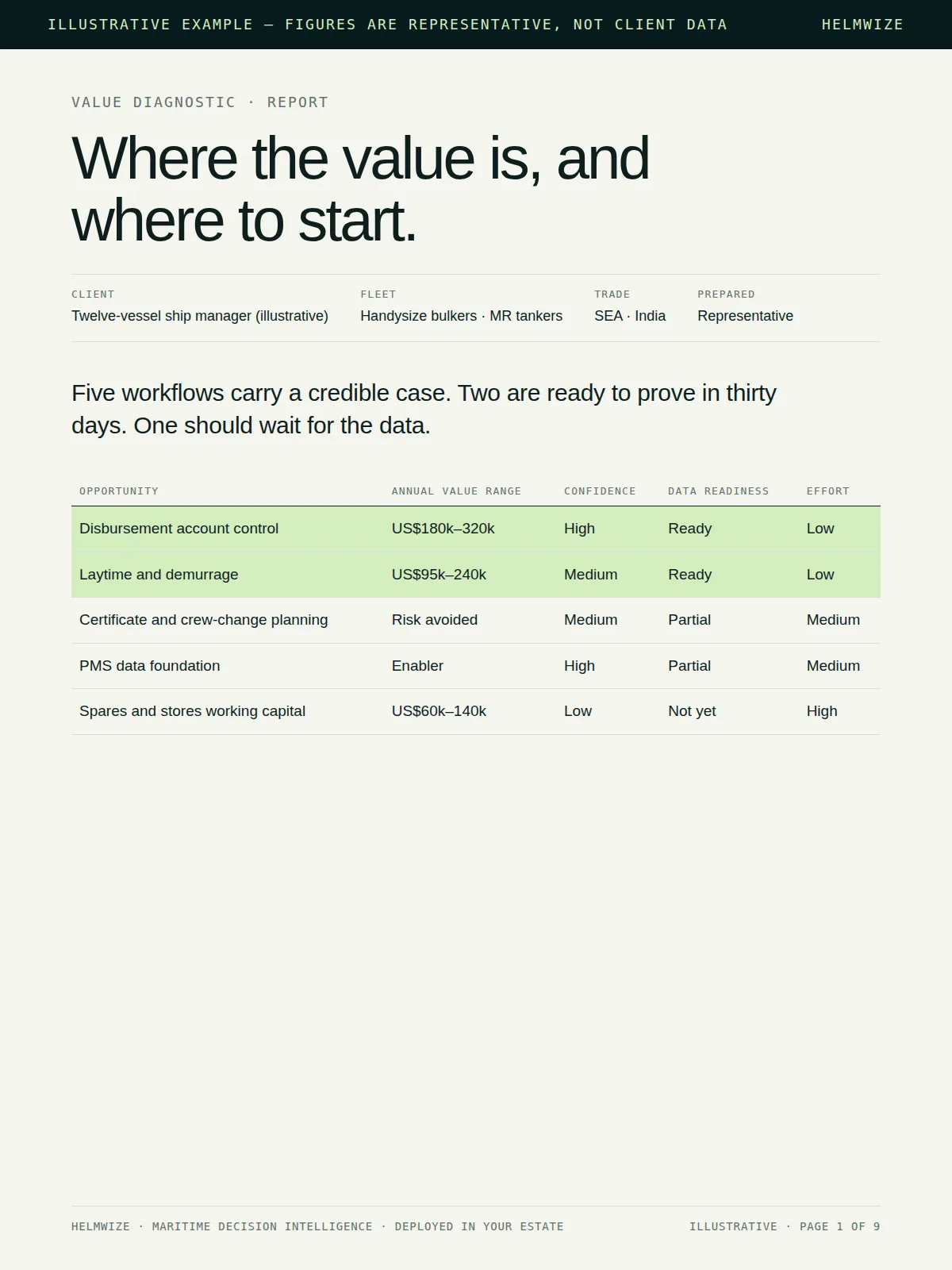
Value Diagnostic report
A ranked opportunity portfolio with sized levers, data readiness per system and a recommended Proof of Value scope. Audience: Managing director, CFO, fleet director.
Illustrative
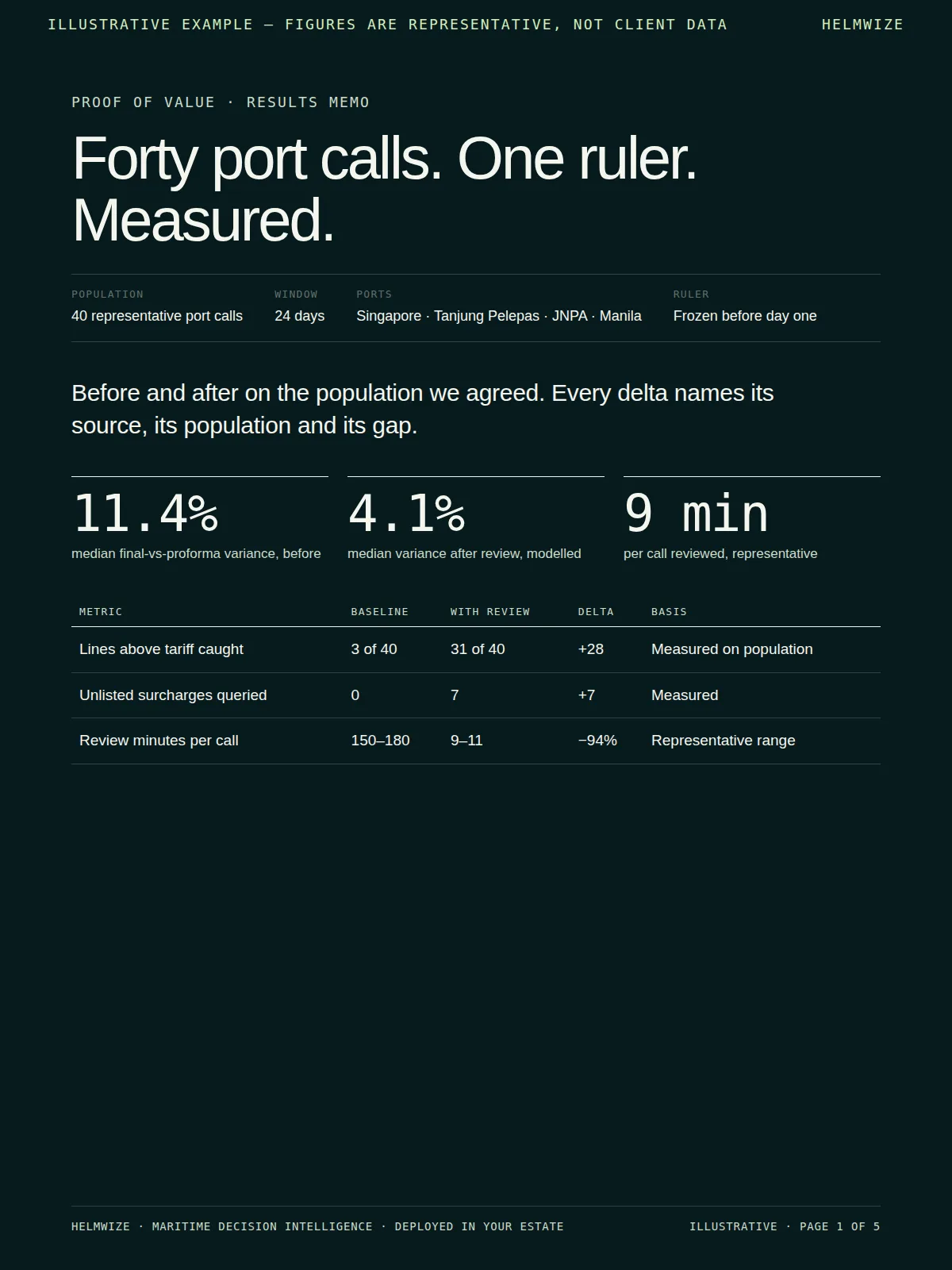
Proof of Value results memo
Before and after on a defined population of port calls, with every delta stating its source, population and gap. Audience: Operations and finance sponsors.
Illustrative
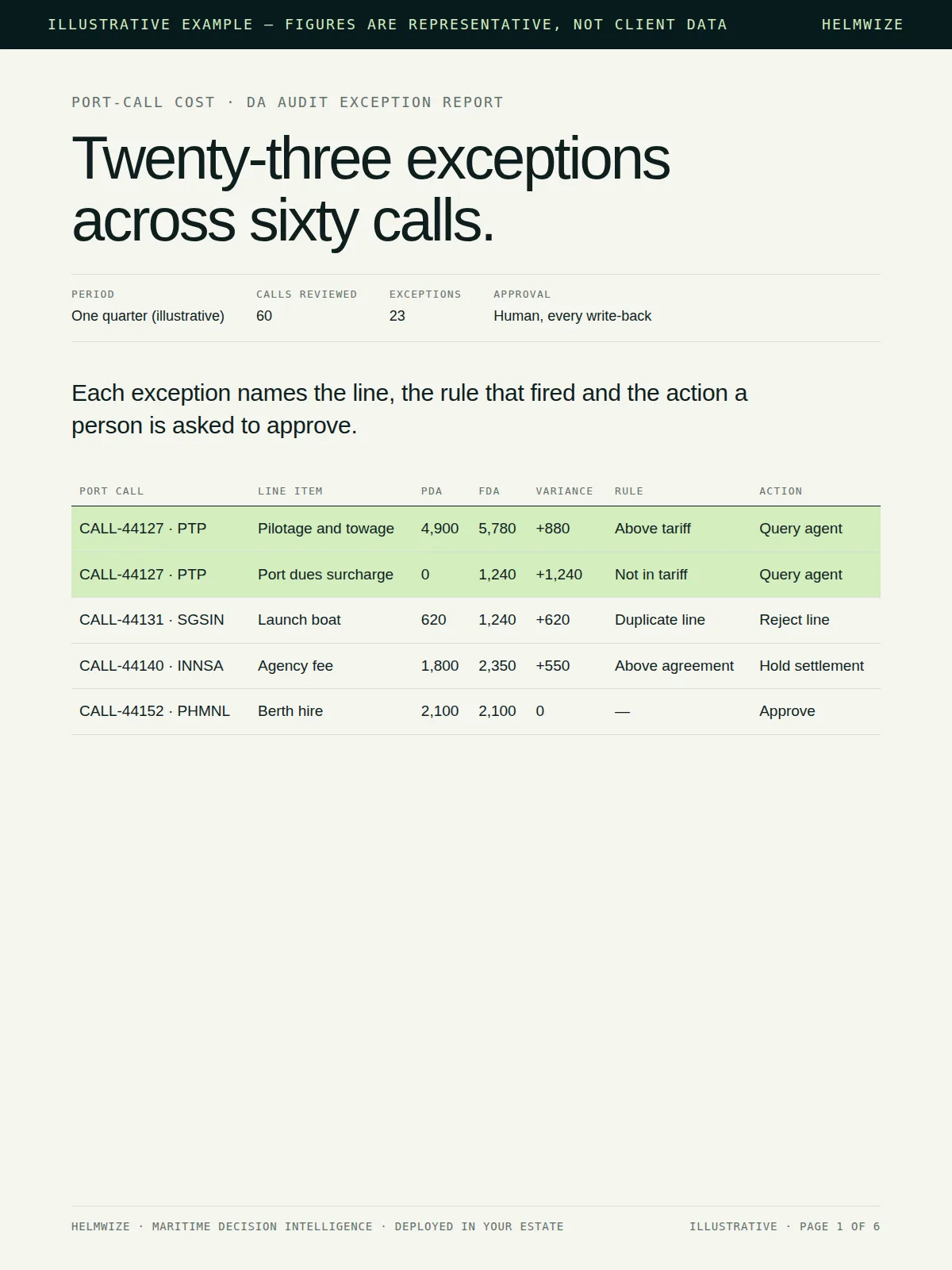
Port-call cost and DA audit exception report
An exception register per call with the rule that fired and the write-back a person is asked to approve. Audience: Port-cost controller.
Illustrative
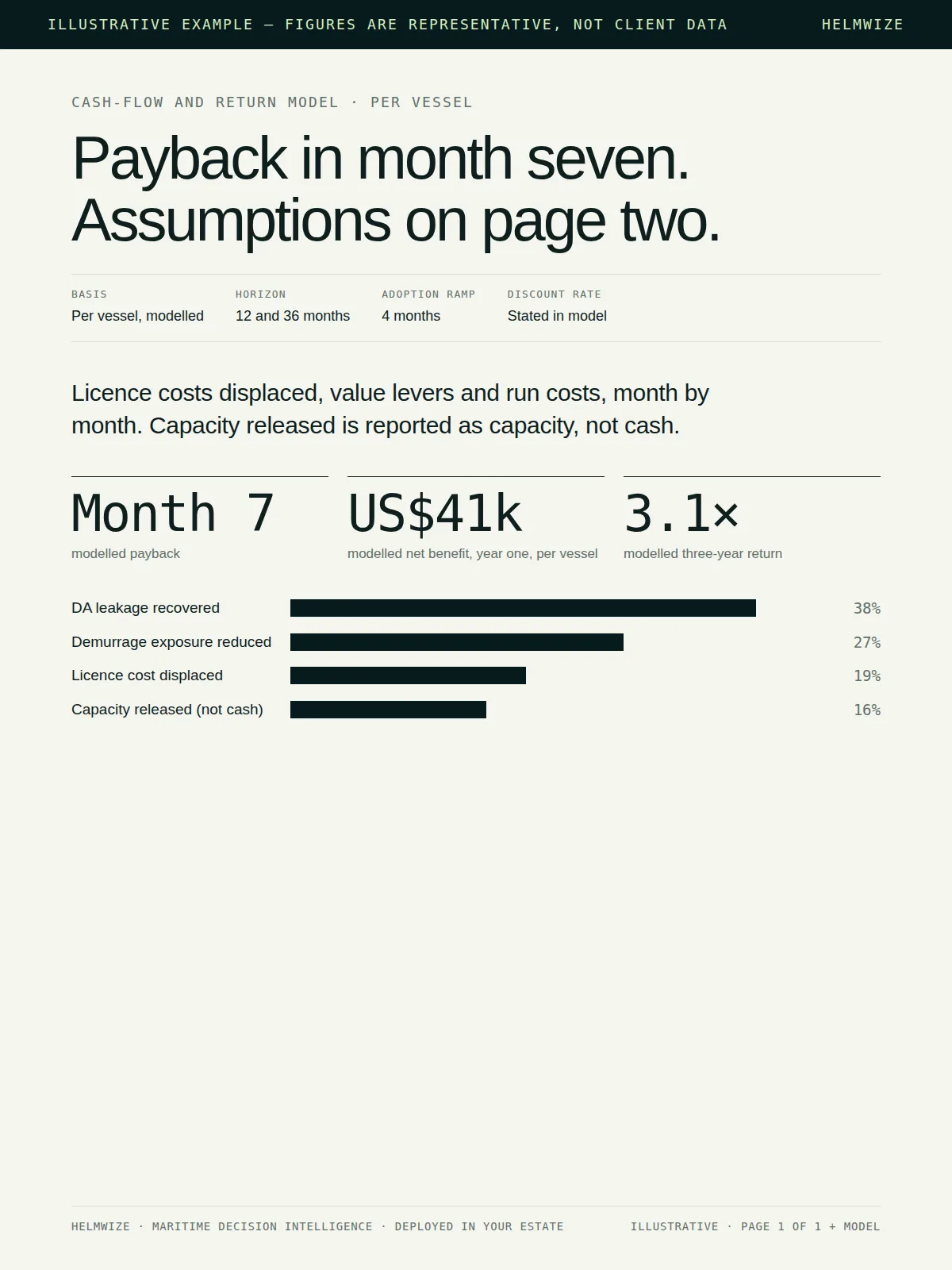
Cash-flow and return model
Twelve- and thirty-six-month cash flow per vessel and per site, licence costs displaced, payback month, all assumptions visible. Audience: CFO.
Illustrative
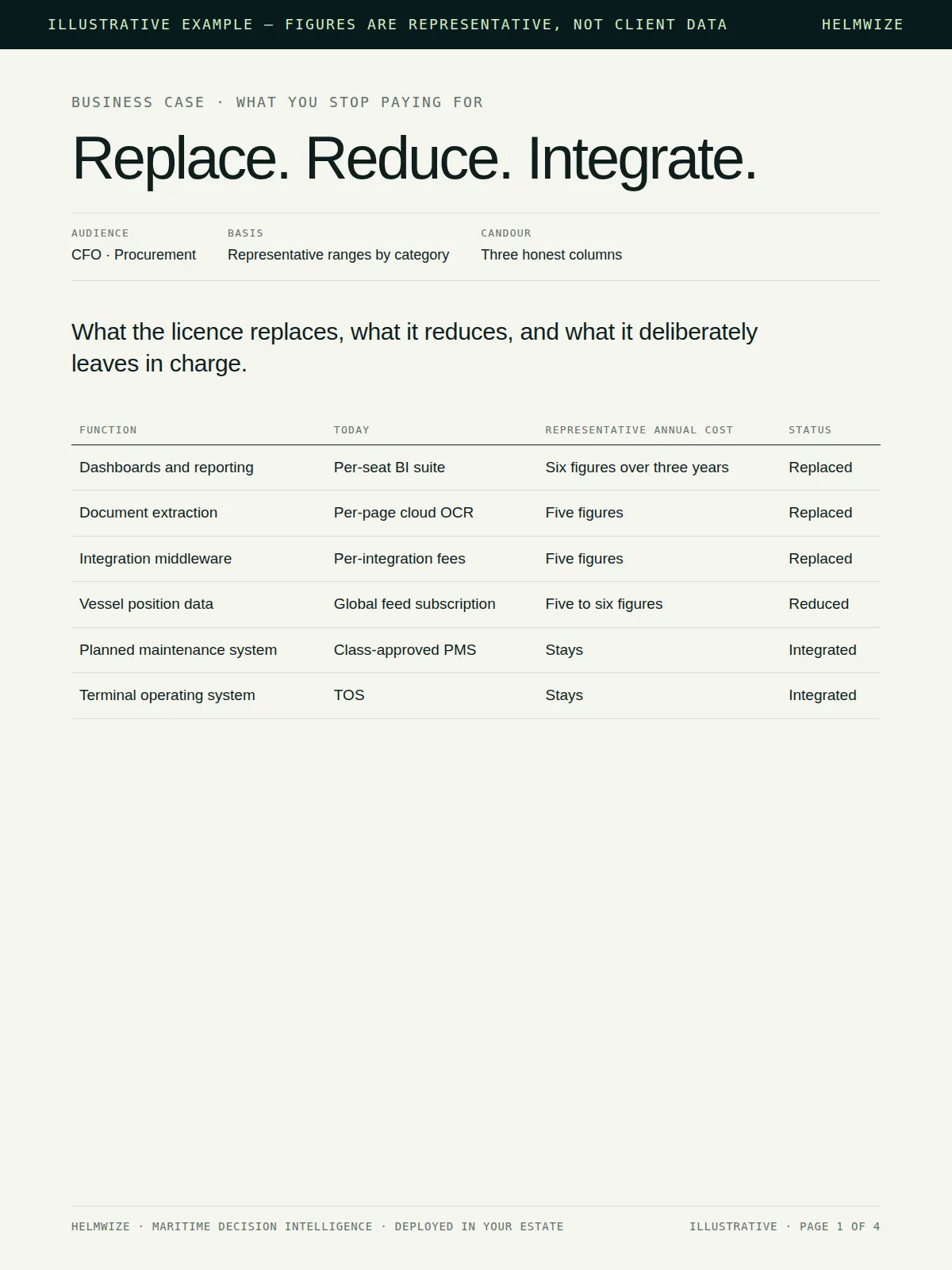
Licence-cost replacement business case
Replace, reduce, integrate — by category, with what you keep and what you stop paying for. Audience: CFO, procurement.
Illustrative
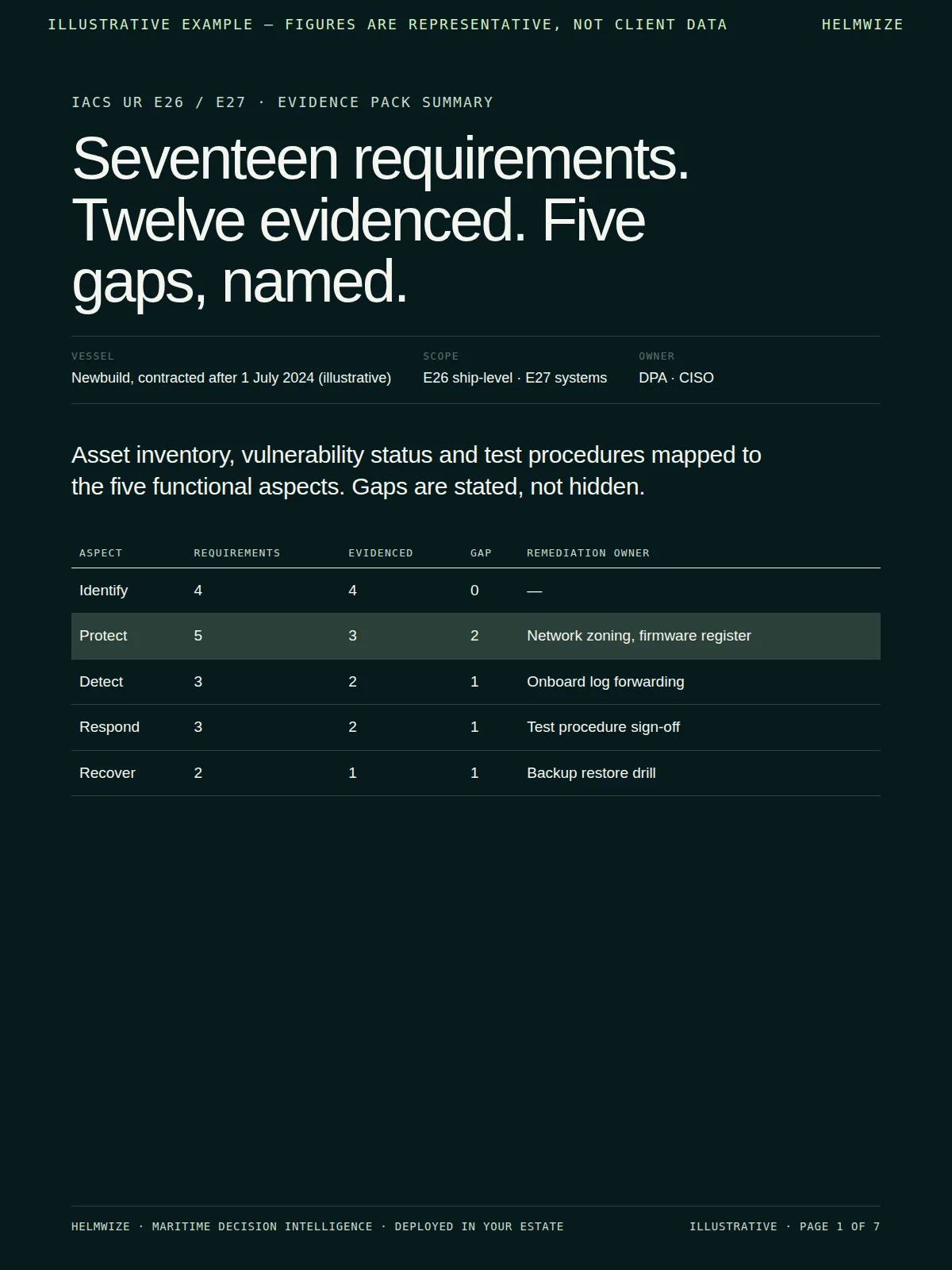
IACS E26 / E27 evidence pack summary
Asset inventory extract, vulnerability status and a mapping to the seventeen requirements with gaps stated. Audience: Designated person ashore, CISO, superintendent.
Illustrative
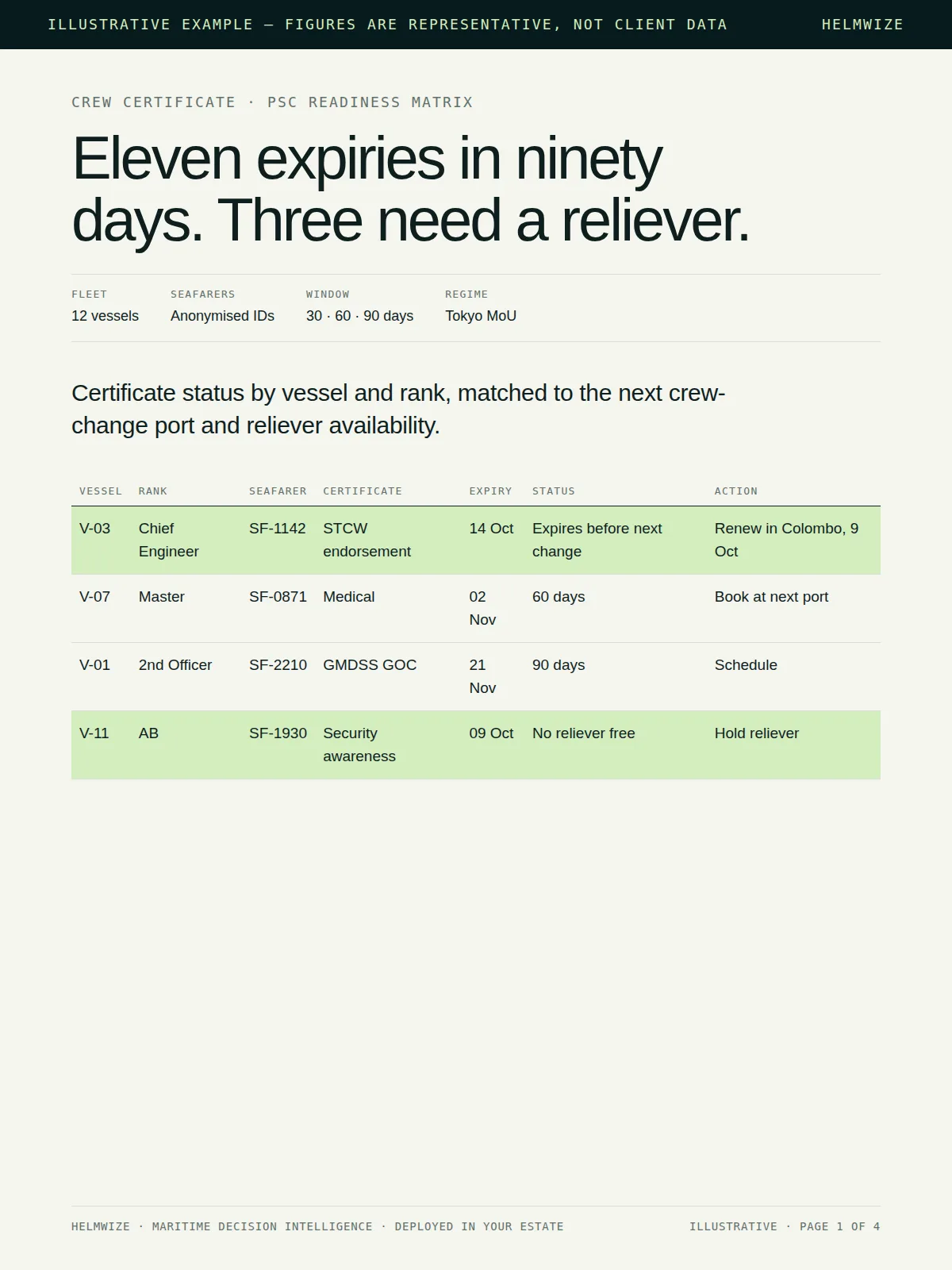
Crew certificate and PSC readiness matrix
Certificate status by vessel and rank, expiries at thirty, sixty and ninety days, MLC readiness and deficiency likelihood. Audience: Crewing manager, DPA.
Illustrative
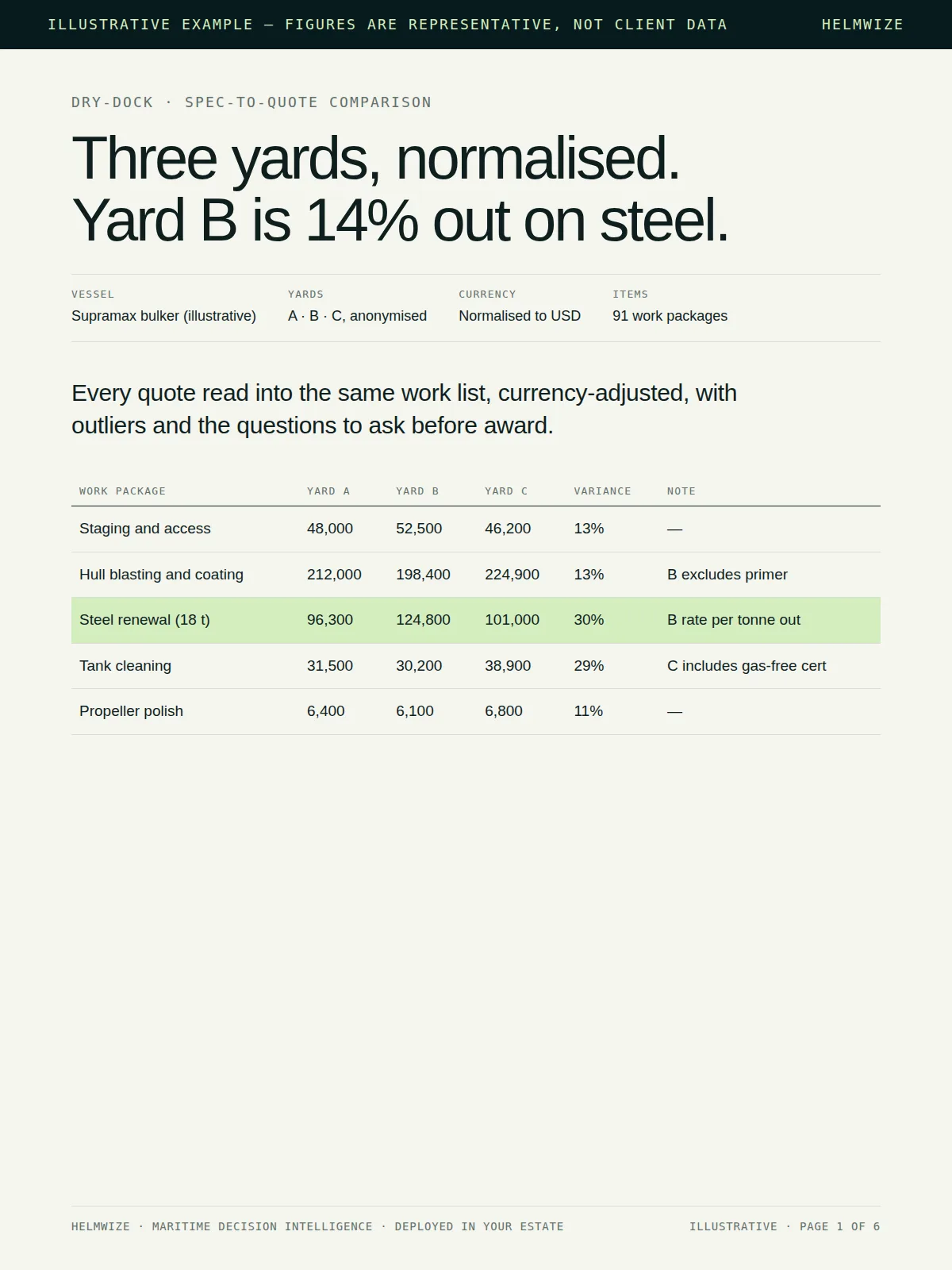
Dry-dock spec-to-quote comparison
Three anonymised yard quotes normalised by work package, with outliers and clarification questions. Audience: Technical superintendent, tender team.
Illustrative
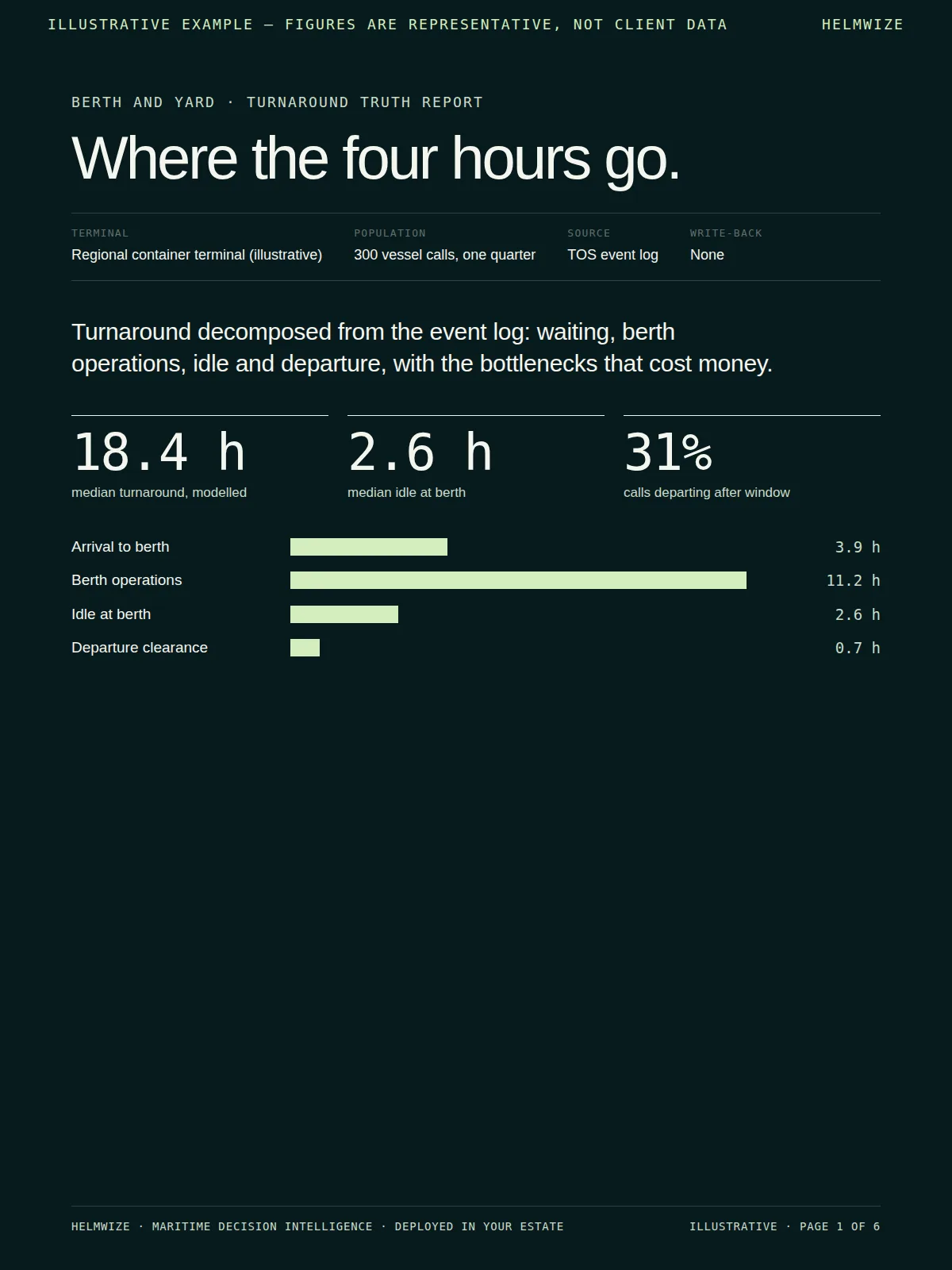
Berth and yard turnaround truth report
Turnaround decomposed from the event log, berth productivity, bottlenecks and their tariff implications. Audience: Terminal operations director.
Illustrative
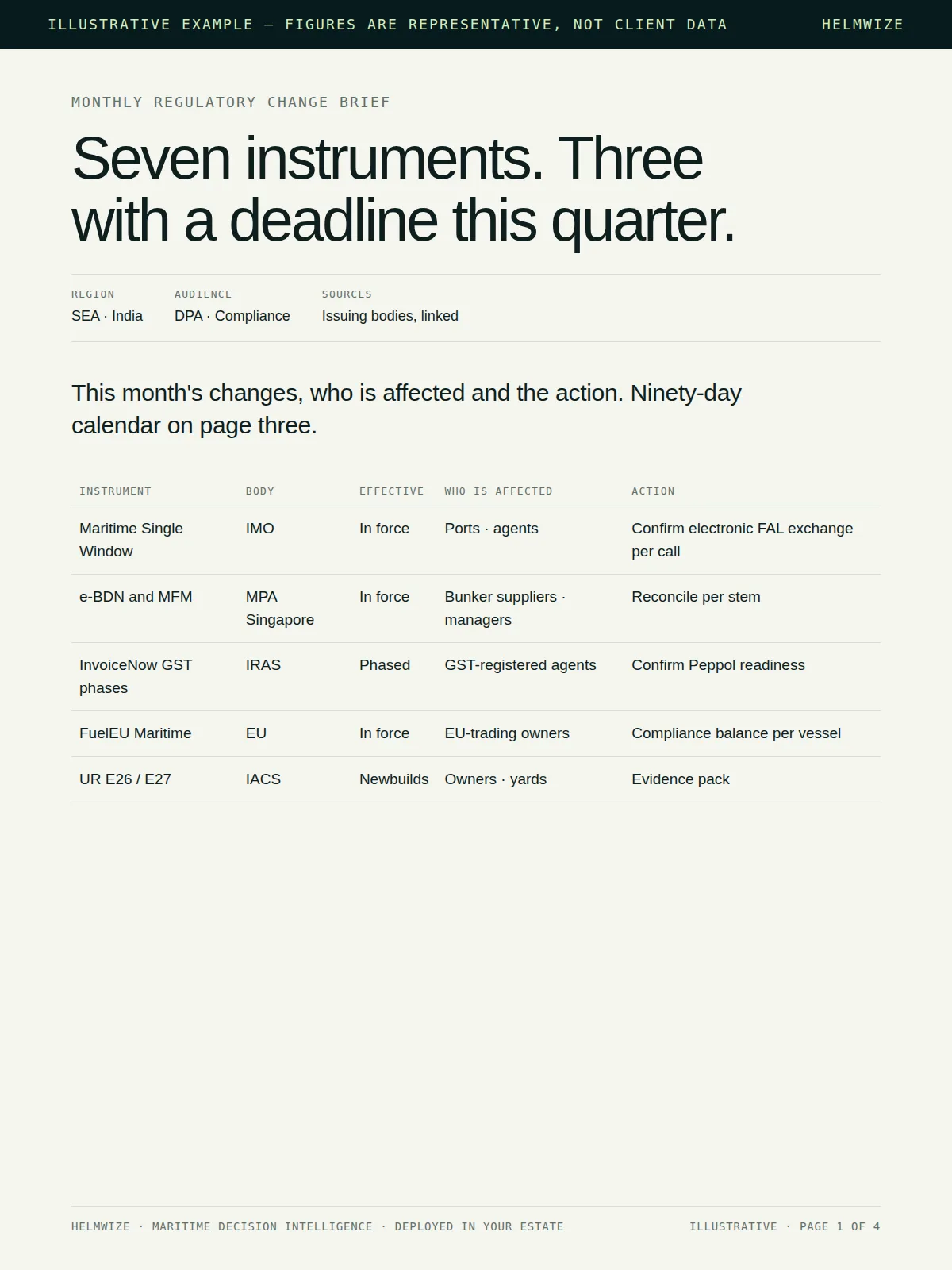
Monthly regulatory change brief
This month's instruments, who is affected, the action, and a ninety-day calendar. Sources linked, never copied. Audience: DPA, compliance.
Illustrative
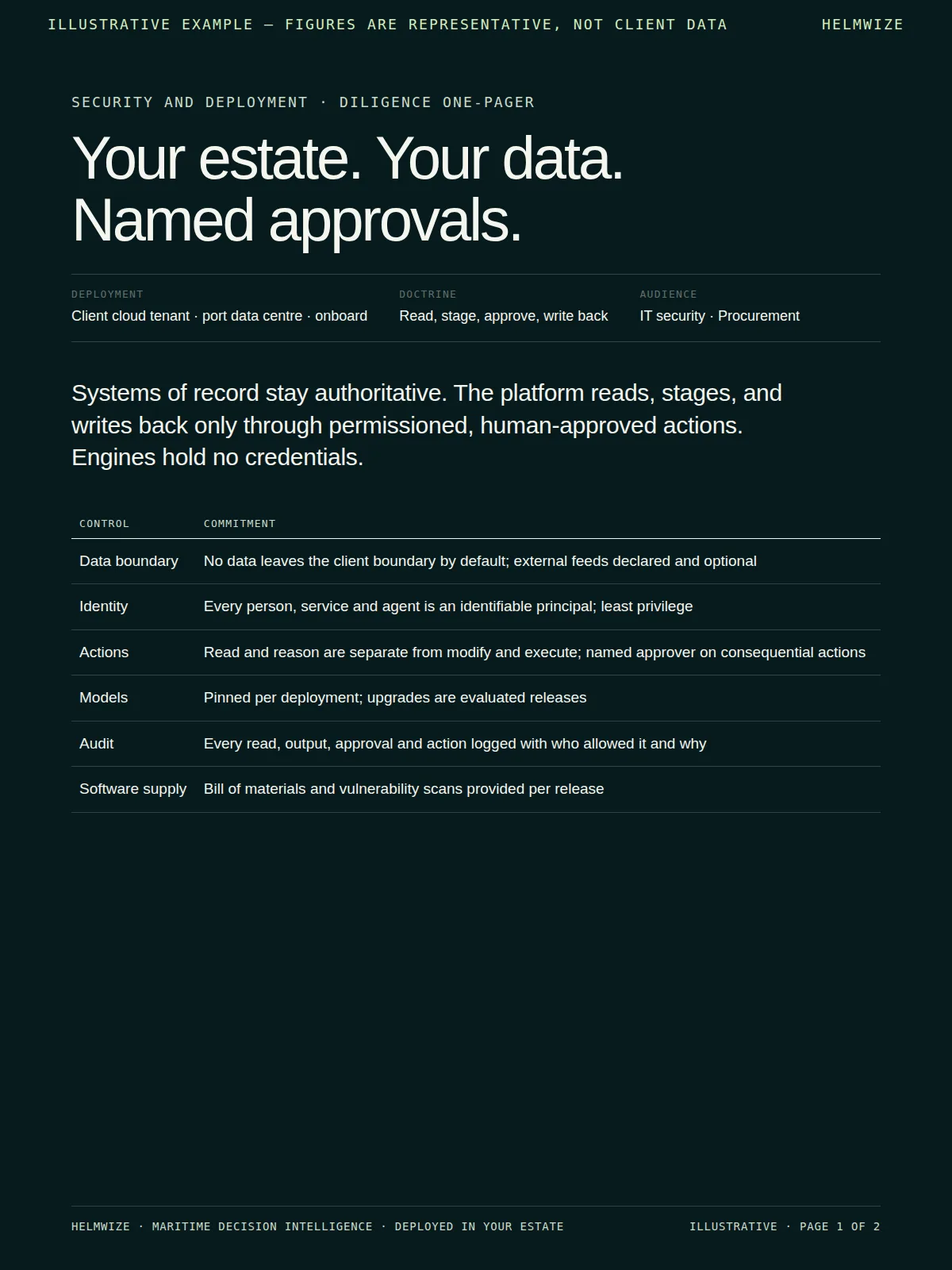
Security and deployment diligence one-pager
Deployment models, the data doctrine, identity and governance components, no-egress diagram, SBOM and scanning. Audience: Client IT security, procurement.
Illustrative
FAQ
Questions
Does it replace our PMS?
No. Keep your systems of record. Add the intelligence between them. Useful AI has to work across those systems without weakening their authority, permissions or audit history.
Does it need a copy of all our data?
The platform runs in your cloud tenant, your port or yard data centre, or onboard. Engines hold no credentials.
What happens when the model changes?
Every production workflow has acceptance tests. One definition, never redefined. Gaps published.
Does the Helmwize platform replace our planned maintenance system, ERP or terminal operating system?
No. Those are systems of record and, in the case of a class-approved PMS, part of your class notation. The platform reads them, stages findings, and writes back only through actions a named person approves.
Can we run the Helmwize platform without any data leaving our environment?
Yes. Every component, including document extraction and the language-model gateway, can run inside your cloud tenant, port data centre or onboard edge node. Where a client permits an external feed, for example commercial AIS, it is declared and optional.
What do the status labels mean?
Labels come from the engineering registry. PLANNED means it is scheduled and not yet deployed. LEGACY means it is being retired. UNVERIFIED is shown for an in-place status until registry.json records verifiedBy and verifiedAt. The website does not edit these labels.
Are the sample reports real client results?
No. They are illustrative composites built from representative ranges and are labelled as such on every page. Named results appear only with a client's written permission.
Can we stop using the Helmwize platform and keep our data?
Yes. Your data stays in your estate in open formats and you keep it when you leave.