
For ports and terminals
Know why the call left late.
For port authorities and terminal operators: turnaround truth from your own event logs, vessel-call exceptions explained, and the tariff and invoice trail reconciled.
Start a DiagnosticPorts and terminals in Southeast Asia, India and Africa are digitalising fast but unevenly. Most have a TOS, a port community system or single window, a billing system and a great deal of email between them, and nobody can say with confidence why a given call departed four hours late or whether a tariff line was applied correctly. Helmwize starts with process truth: reconstructing the vessel call from the event logs you already keep, comparing it to the designed path and separating the causes, crane availability, pilot boarding, documentation, from the noise. The Diagnostic runs in two to four weeks on one terminal or one authority. We prove the first workflow on live calls, then the platform runs in your own data centre or cloud tenant under your procurement and cyber rules.
Where we start
Which workflows are worth fixing first?
Berth and yard turnaround truth
The actual sequence of every call from the logs, conformance against the planned berth window, and the recurring delay causes ranked by cost. L4 Capacity. Ledger: Revenue per berth.
Vessel-call exceptions
Calls that are drifting from plan surfaced while they can still be recovered, with the evidence and the responsible party beside the exception. L2 Cycle time. Ledger: Port days and waiting cost.
Tariff and invoice reconciliation
Every invoice line checked against the published tariff and the recorded services, so under-billing and disputes are caught before the agent does. L3 Cost per transaction. Ledger: Port dues and service revenue.
Single-window and cyber readiness
The IMO FAL single-window obligations and IACS-aligned cyber controls mapped to your systems, with the gaps a person needs to close and the evidence an auditor needs to see. L8 Compliance. Ledger: Penalty and audit exposure.
One real decision
A recommendation should be something you can inspect.
Departed 3 h 50 m after the berth window.
- What changed
- Cargo operations completed on time. Pilot boarded 2 h 10 m after ready; outbound clearance completed 1 h 40 m after that.
- Evidence
- TOS event logPilot dispatch recordClearance timestampsBerth plan
- Exposure
- One berth slot lost; next vessel waited 2 h 30 m at anchorage
- Confidence
- High on the sequence. Medium on the cause of the pilot delay.
Suggested step
Review pilot allocation for the evening window. Check the clearance dependency on customs release.
Illustrative workflow, not a client result. This example changes nothing outside the page: no schedule change, no record, no message.
Systems of record
What stays authoritative?
TOS, Port community system / single window, Billing, VTS. Helmwize connects the context. It does not replace these systems.
For ports and terminals
Turnaround truth from the event log you already keep.
The terminal operating system stays in charge. The platform reads its events, reconciles the tariff against the disbursement account, and produces the single-window and cyber evidence a port authority is now required to show.
Berth and yard turnaround truth
Reads: Terminal operating system event logs, Vessel call records, Berth plans, Tariff. Turnaround decomposed from arrival to departure, berth productivity, and the bottlenecks that cost money. GATE: The terminal reads its own event log; nothing is written back.
PLANNEDBUILD
Disbursement account audit rules
Reads: Proforma DA, Final DA, Port tariff, Agency agreement, Prior calls at the same port. An exception register per port call: line item, proforma, final, variance, rule triggered, recommended action. GATE: A port-cost controller approves each write-back.
PLANNEDBUILD
Maritime Single Window and FAL evidence
Reads: FAL forms, Port call notifications, Single-window submissions, Vessel and cargo declarations. A per-call record showing which declarations were exchanged electronically, when, and what remains manual. GATE: The port authority owns the record; the platform only reports the gap.
PLANNEDBUILD
IACS UR E26 / E27 evidence pack
Reads: Onboard and shore asset inventory, Vulnerability scans, Network zoning, Test procedures. An evidence pack mapped to the five functional aspects and seventeen requirements of UR E26, with gaps stated. GATE: The designated person ashore or CISO signs the pack.
PLANNEDPACKAGE
What you receive
Reports a port authority can table.
Illustrative examples. Figures are representative, not client data.
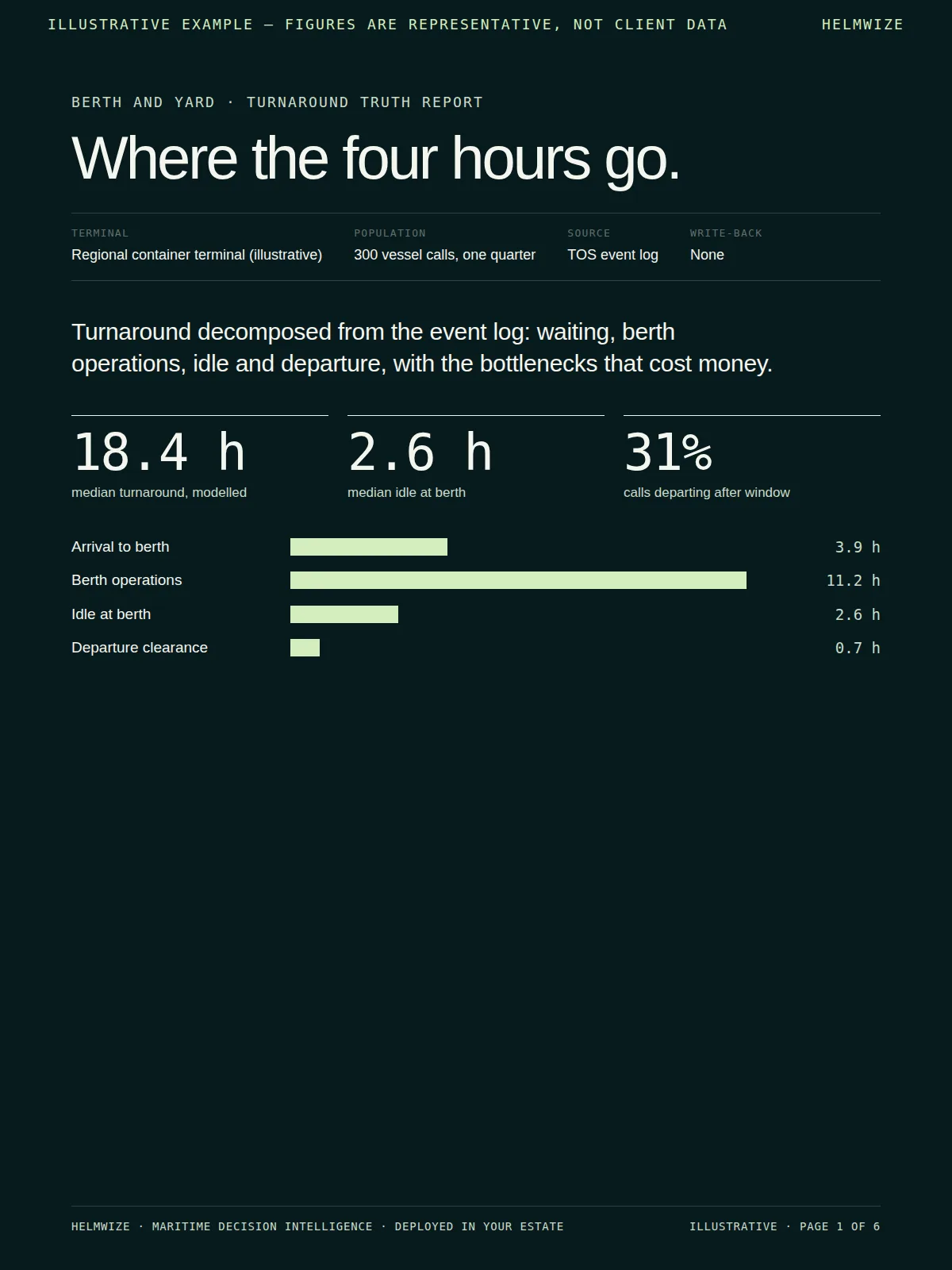
Berth and yard turnaround truth report
Turnaround decomposed from the event log, berth productivity, bottlenecks and their tariff implications. Audience: Terminal operations director.
Illustrative
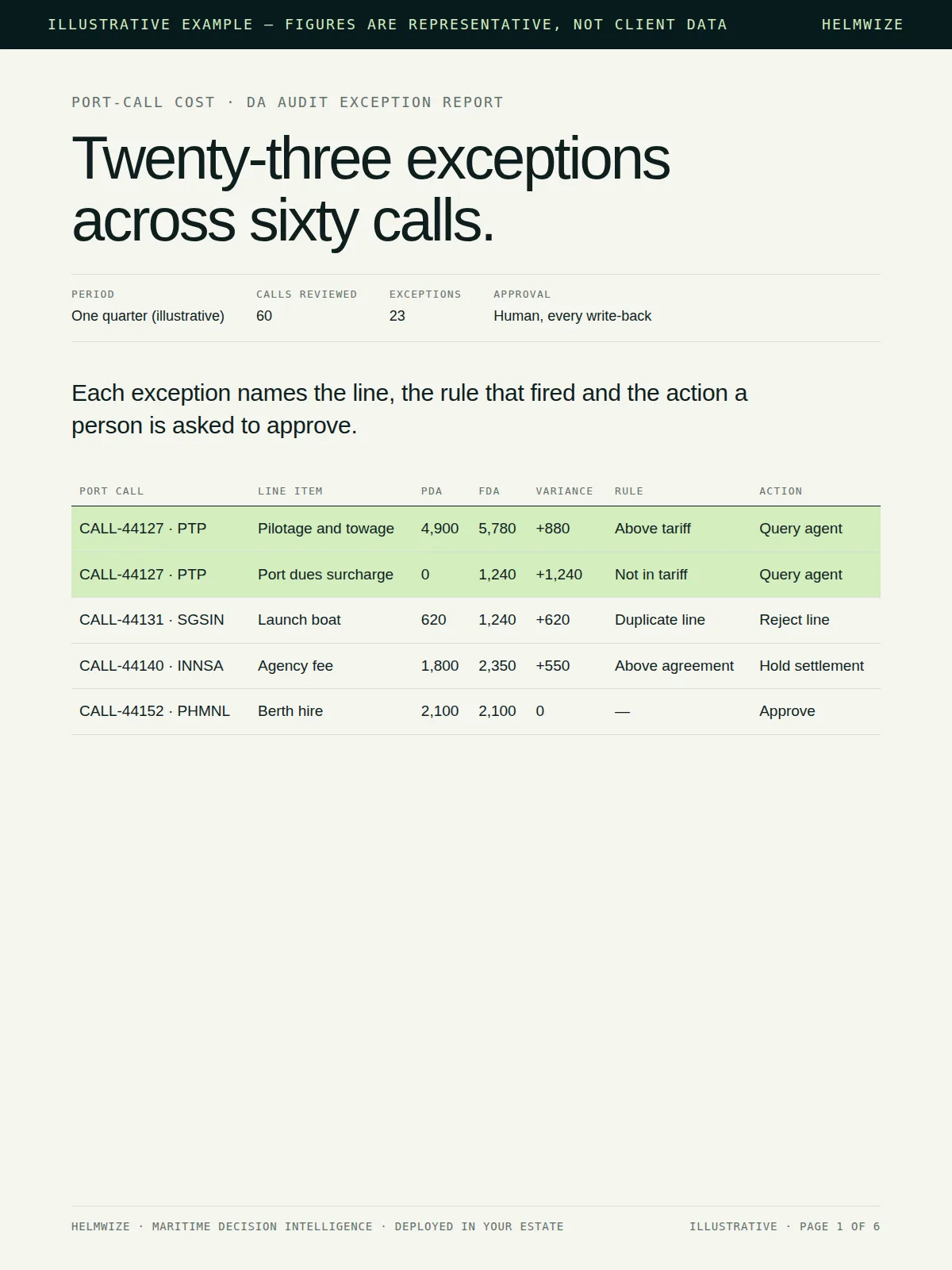
Port-call cost and DA audit exception report
An exception register per call with the rule that fired and the write-back a person is asked to approve. Audience: Port-cost controller.
Illustrative
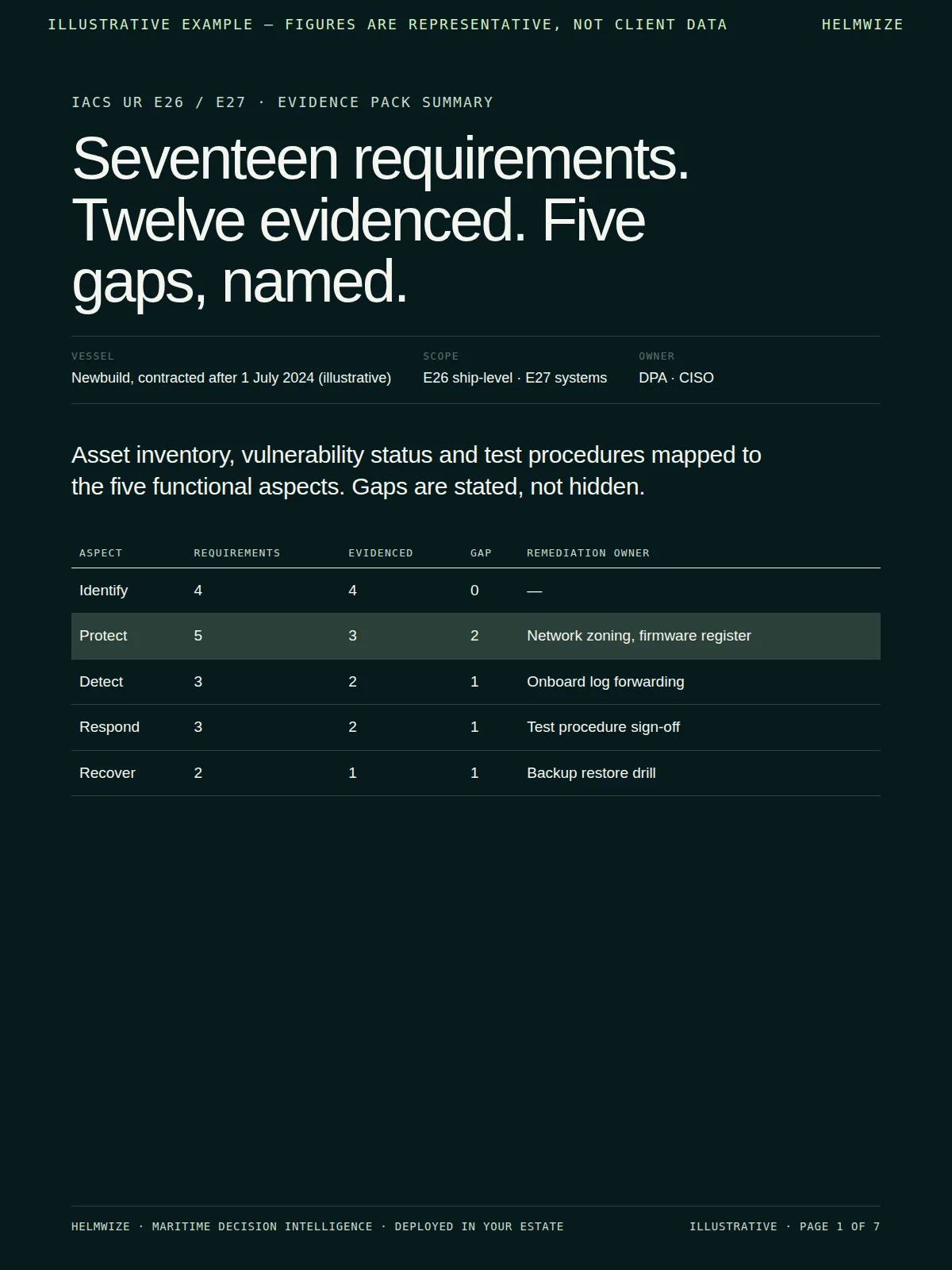
IACS E26 / E27 evidence pack summary
Asset inventory extract, vulnerability status and a mapping to the seventeen requirements with gaps stated. Audience: Designated person ashore, CISO, superintendent.
Illustrative
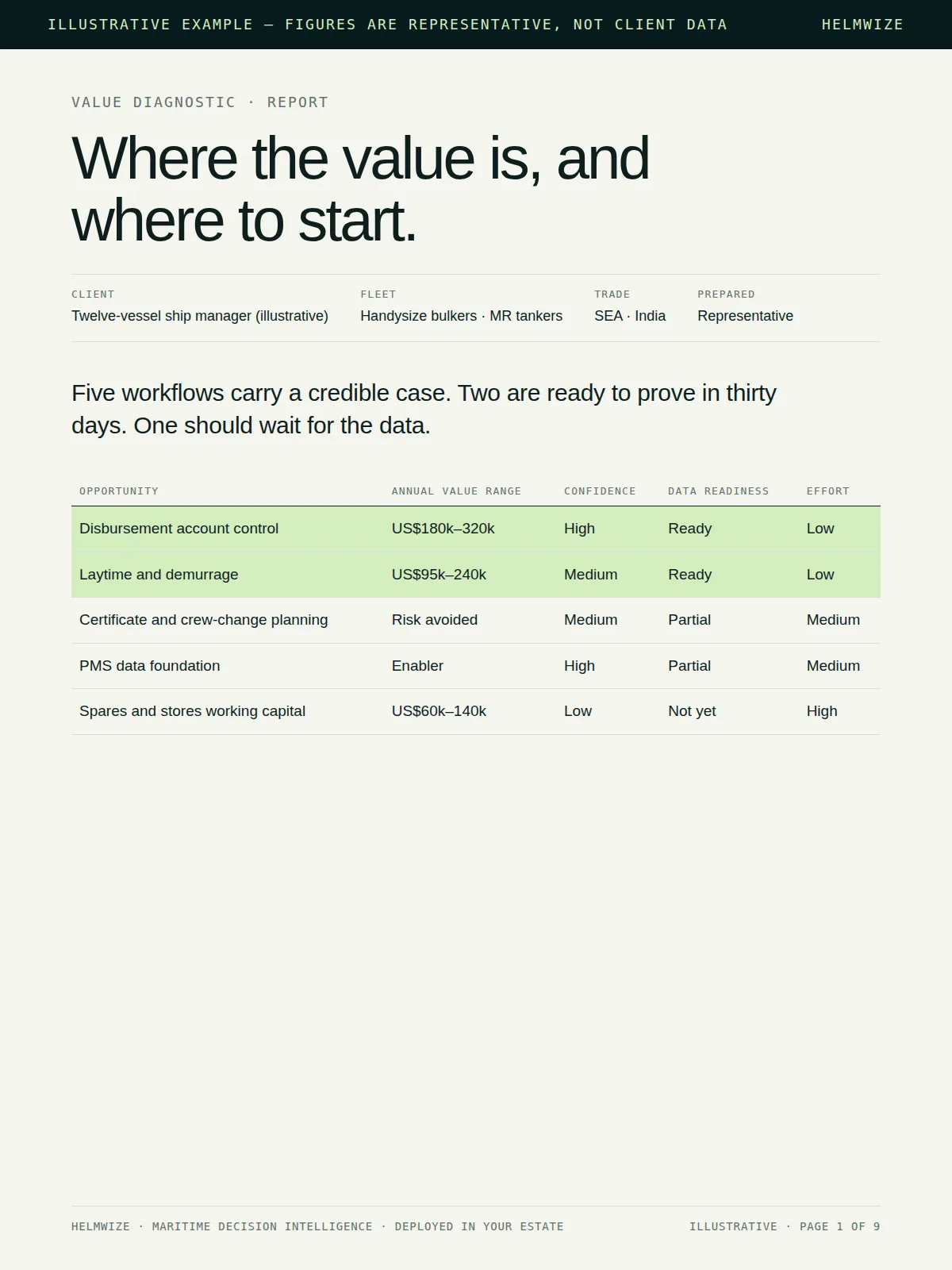
Value Diagnostic report
A ranked opportunity portfolio with sized levers, data readiness per system and a recommended Proof of Value scope. Audience: Managing director, CFO, fleet director.
Illustrative
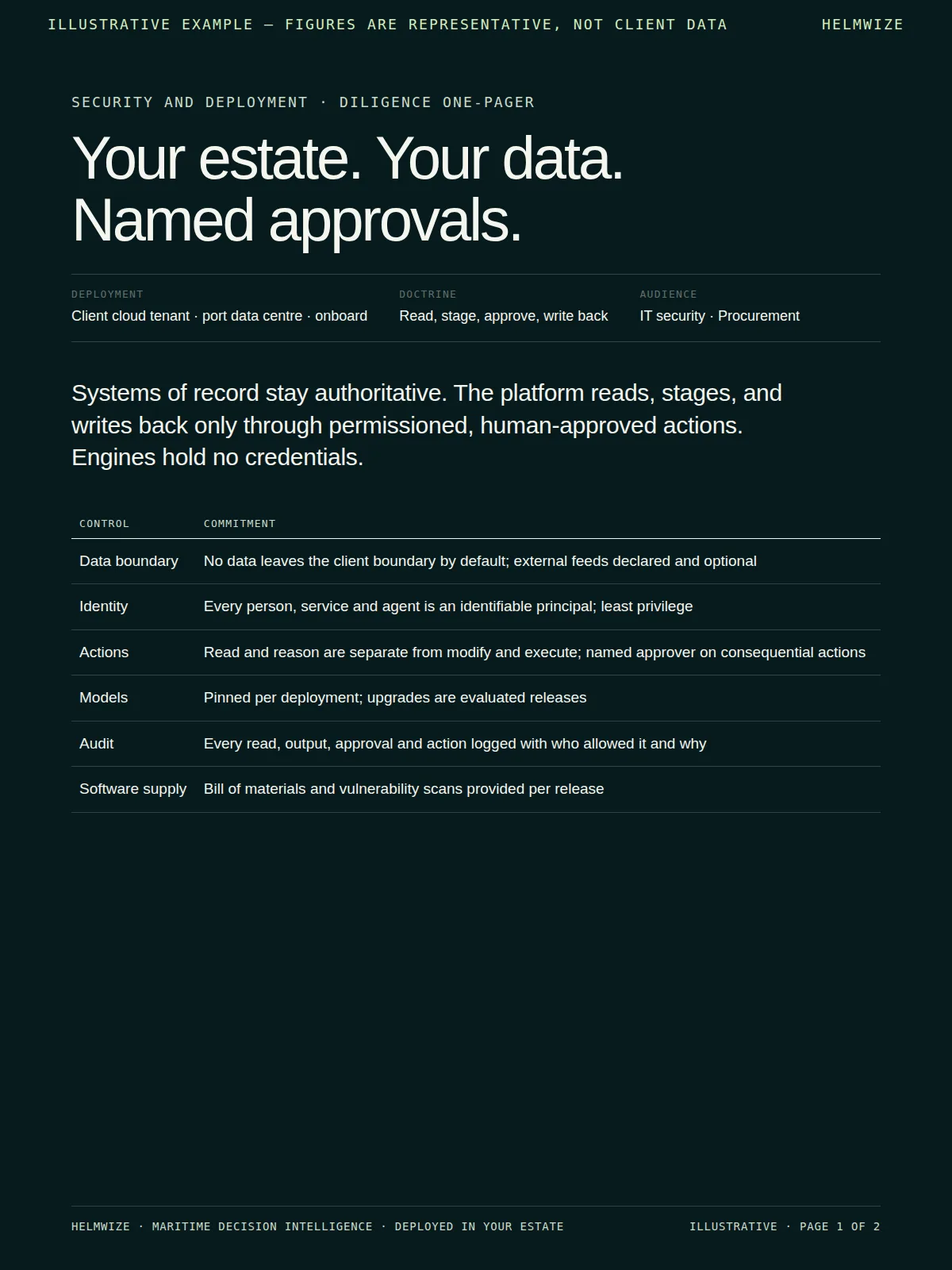
Security and deployment diligence one-pager
Deployment models, the data doctrine, identity and governance components, no-egress diagram, SBOM and scanning. Audience: Client IT security, procurement.
Illustrative
What you stop paying for
Keep the TOS. Own the analytics.
Representative ranges by category.
Costs are representative ranges by category · not vendor price lists
| Function | Incumbent | Representative cost | With Helmwize | Verdict |
|---|---|---|---|---|
| Terminal analytics and dashboards | TOS BI module or commercial BI suite | Representative: five to six figures a year | Dashboards built on your own data | replace |
| Port mapping and berth visualisation | Commercial GIS | Representative: five figures a year | Charts and tiles served in your estate | replace |
| Integration middleware | iPaaS per integration | Representative: per-integration monthly fee | Connectors and file drops you already operate | replace |
| Terminal operating system | TOS | Stays | The platform reads the event log and berth plan | integrate |
Compliance
Mandatory since 2024. Evidence due every call.
| Instrument | Body | Effective | Affects | Evidence needed |
|---|---|---|---|---|
| IMO FAL Convention amendments — mandatory Maritime Single Window | International Maritime Organization | 2024-01-01 | Port authorities, Agents, Ports and terminals | Electronic exchange of arrival, stay and departure declarations for every call |
| IACS UR E26 and E27 cyber resilience | International Association of Classification Societies | 2024-07-01 | Ships contracted for construction on or after the date, Yards, Equipment suppliers | Asset inventory, test procedures and evidence for seventeen requirements |
FAQ
Questions
We already have a port community system. What does this add?
The PCS records what happened. Helmwize explains why, ranks the causes by cost and stages the action. It reads from the PCS; it does not replace it.
Can this run inside our own data centre?
Yes. Port and yard data centre deployment is the default for public authorities, with no data leaving your boundary and engines that hold no credentials.
How does this fit procurement?
The Diagnostic is a fixed-fee study that produces the specification. Proof of Value and deployment are priced against that specification, by site, so it can be tendered cleanly.